
The Perfect Leg Workout: Science-Backed Muscle Growth Plan
Build stronger, more balanced legs with a science-backed workout that targets quads, hamstrings, glutes, and calves efficiently.
A well-designed leg workout should do more than leave you tired. It should train the major lower-body muscle groups through a mix of compound lifts, targeted accessory work, and enough weekly volume to drive progress. The most effective approach is simple: prioritize exercises that allow heavy loading, include movements that challenge muscles through a full range of motion, and recover well enough to repeat the effort consistently.
The foundation of a strong leg session is usually a squat pattern. Back squats, front squats, and leg presses all emphasize the quadriceps while also recruiting the glutes and adductors. Among these, the best choice is the one you can perform with good technique and progressive overload. If mobility or back comfort is a concern, the leg press or hack squat can provide a stable way to train hard without sacrificing stimulus.
After the main squat movement, hinge-based exercises are essential for balanced development. Romanian deadlifts, stiff-leg deadlifts, and hip thrusts place greater emphasis on the hamstrings and glutes, which are often undertrained in programs that focus only on squatting. Research consistently shows that combining knee-dominant and hip-dominant movements leads to better overall lower-body development than relying on one pattern alone.
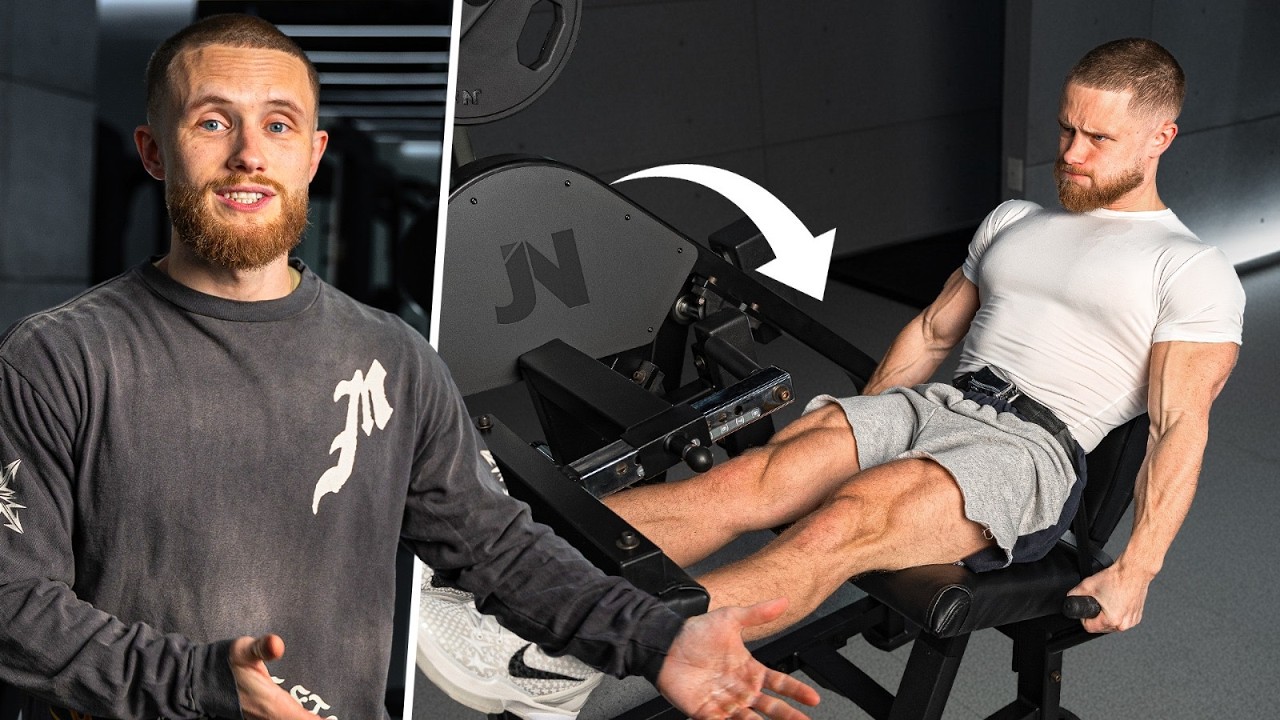
Accessory work matters because the legs are made up of multiple muscles with different functions. Leg extensions can isolate the quadriceps, while lying or seated leg curls directly train the hamstrings. Single-leg exercises such as Bulgarian split squats or walking lunges improve stability, expose side-to-side imbalances, and add valuable volume without requiring maximal loads. These exercises are especially useful for athletes and anyone looking to build more complete leg strength.
Calves should not be ignored. The gastrocnemius and soleus respond best to direct training with both straight-knee and bent-knee calf raises. Because these muscles are used frequently in daily movement, they often need a higher training frequency or more total sets to grow. Controlled reps and a pause in the stretched position can improve the quality of each set.
A science-backed leg workout might look like this:
- Back squat or leg press: 3-5 sets of 5-8 reps
- Romanian deadlift: 3-4 sets of 6-10 reps
- Bulgarian split squat: 3 sets of 8-12 reps per leg
- Leg curl: 3 sets of 10-15 reps
- Leg extension: 2-3 sets of 10-15 reps
- Standing calf raise: 3-4 sets of 8-15 reps
Rest periods should be long enough to maintain performance, especially on compound lifts. Two to three minutes between heavy sets is usually appropriate, while isolation exercises can be performed with slightly shorter rest. Training close to failure is important, but not every set needs to be all-out. Leaving one or two reps in reserve on most sets can help manage fatigue while still supporting muscle growth.
For best results, train legs one to two times per week and aim to add weight, reps, or sets over time. Consistency, exercise selection, and progressive overload matter more than chasing novelty. The perfect leg workout is not the most complicated one; it is the one that covers the major movement patterns, challenges each muscle group, and can be repeated long enough to produce measurable gains.
What's Your Reaction?
 Like
0
Like
0
 Dislike
0
Dislike
0
 Love
0
Love
0
 Funny
0
Funny
0
 Wow
0
Wow
0
 Sad
0
Sad
0
 Angry
0
Angry
0